HOME | Contact | Place Orders
1 cent | 5 cent | 10 cent | 25 cent
50 cent | Dollars | Newfoundland | Tokens
World coins
 |
 |
EDWARD VII
|
1902 50 Cent
|
1903 H 50 Cent
|
1904 50 Cent
|
1905 50 Cent With a mintage of only about 40,000 the 1905 half dollar is by far the rarest of the Edwardian series and finding high grade examples is challenging. This is why in grades of VF-20 or higher than are more expensive and much more difficult to find than 1948 silver dollars.
|
1906 50 Cent
|
1907 50 Cent
|
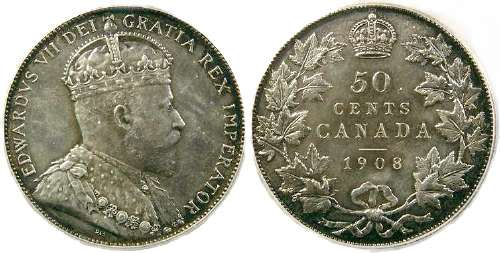
The Royal Canadian Mint opened in Ottawa in 1908 after which nearly all Canadian coins were minted in Canada. While the designs remained the same, the die axis for was changed from "coinage" to "medal", except for the 1 cent coins which had always been made at medal axis. Coinage die axis means that if you place your fingers above and below the portrait then spin the coin around the other side comes out upside down. Medal axis means it comes out the same way up.
1908 50 Cent
|
1909 50 Cent
|
1910 Victorian leaf 50 Cent Earlier examples of the 1910 half dollars have a reverse with what is known as the Victorian leaves design which had been in use since the first issues of 1870. The leaves to either side of the date are more pointed and slightly elongated so that they end closer to the denticles, but a distinctive feature is very narrow rims which is clear even on worn examples. These are the scarcer of the two types.
|
1910 Edwardian leaf 50 Cent Later in 1910 the reverse was redesigned to what is known as the Edwardian leaves type, where the leaves to either side of the dates are more rounded and slightly shorted so they end further from the rim, and at the same time the rims were made wider. On worn examples they are most easily differentiated by the rim width.
|
I have noticed that from 1910 until about 1915, with the introduction of the Edwardian leaf reverse type, the coins often wear excessively in the center of the reverse so that on many examples VG or lower grade the CENTS CANADA above the date will be partly or even mostly worn off. It does not happen on every coin, but to most of them and should be an expected part of the grade. When the weakness is excessive I will grade these with a split grade, with the first tone being for the obverse and the second lower one indicating a very weak reverse (ie. G-6/G-4) There appears to have been a correction to the design around 1916, as examples after than are not nearly as affected by this.
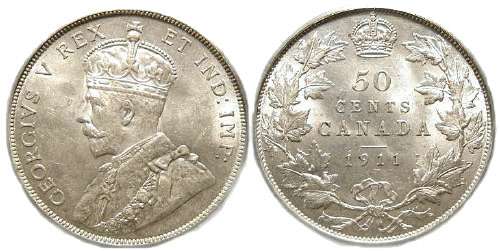
1911 50 Cent George V coins were introduced in 1911 with DEI GRATIA, Latin for God's Grace, omitted from the obverse inscription. Known as the GODLESS COINS there was a public outrage so in 1912 DEI GRATIA returned to Canadian coins.
|
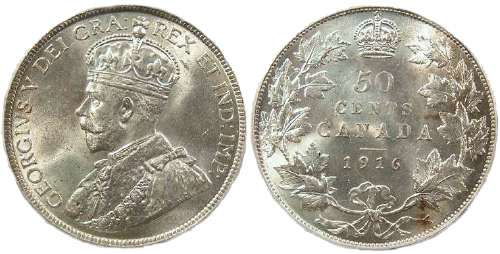
1912 50 Cent
|
1913 50 Cent
|
1914 50 Cent
|
No Canadian half dollars were struck in 1915.
1916 50 Cent
|
1917 50 Cent
|
1918 50 Cent
|
1919 50 Cent
|
While there were no design changes between 1912 and 1936, in 1920 the alloy was reduced from 92.5% silver (sterling) to 80% silver where it remained until 1967.
1920 50 Cent There are two varieties of the 1920 50 cents listed in the standard reference, the narrow 0 (also known as the small 0) and the scarcer wide 0 (also known as the large 0). The the narrow (small) 0 is defined either by the size or the inside of the 0 being narrower and slightly pointed at the top and bottom, but I am finding examples with the narrow comes in two sizes so it is best to look at the slightly pointed inside to the 0. The wide 0 rounder inside and I and I have only onticed one size.
|
1921 50 Cent Over 200,000 Canadian half dollars were minted in 1921 but there was no demand so nearly all sat in the mint unused until 1928 when the mint master melted them down and likely used the metal to mint 1929's. No one knows how many were issued but there are less than 100 now known to still exist and it is likely many of those left the mint in the pockets of mint visitors taking home a souvenir of new coins but having to spend them during the depression. I am always looking to buy them in just about any grade.
|
With no demand for half dollars during most of the 1920's, none were struck from 1922 to 1928.
1929 50 Cent
|
Demand for 50 cent coins remained low during the depression, with none struck in the years 1930, 1933 and 1935, with only small mintages of 1931, 1932, 1934 and 1936. By 1937 demand increased and half dollars were once again issued in large numbers.
1931 50 Cent
|
1932 50 Cent Just over 19,000 1932 50 cents were struck, only a few hundred more than the 1948 dollar. They were not thought of as rare at the time so most seen today circulated to often heavily worn, with finding high grade examples difficult. The scarcity was not recognized until the 1990's at which time prices rose significantly and today in a grade above XF-40 they are more expensive than 1948 dollars. The relief on 1932 50 cents appears to be different than other dates and the high point of the crown band wears very quickly relative to the rest of the coin. These are graded to allow for this and even in F-12 and F-15 the middle of the crown band will be slightly worn through but the reverse leaves will have the same amount of wear as a F-12 or F-15 on other dates.
|
No Canadian half dollars were struck in 1933.
1934 50 Cent Just over 39,000 1934 50 cents were struck which is still a very low mintage, and like 1932 50 cents were not thought of as scarce while such coins still circulated and finding examples above VF-20 is difficult.
|
No Canadian half dollars were struck in 1935.
1936 50 Cent The mintage of 1936 50 cents, at just under 39,000, is only slightly less than in 1934 and they to are difficult to find above VF-20.
|
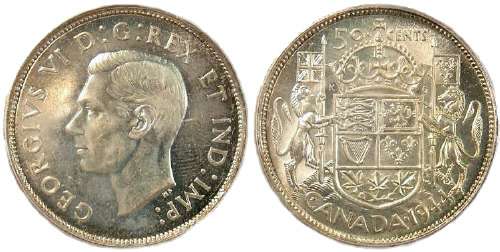
With the depression ending, as George VI came to the throne the demand for 50 cent coins increased and mintages increased dramatically starting in 1937. Through the 1940's mintages for most years exceeded a million coins, with the exceptions being 1947 maple leaf and 1948 (both made in 1948 as discussed below) and 1949 which was nearly a million. All of these dates are often seen with a fair amount of wear on them, showing they circulated widely.
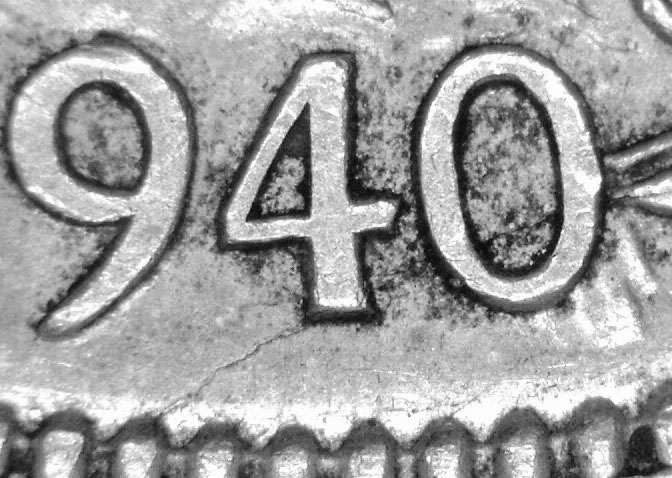
There is an odd feature in the George VI half dollars with many dies cracking from the unicorn's hoof across the last digit or digits of the date, sometimes also propagating in the other direction as well and reaching the rims. It happens in the same place in many dies in many different years. I have noticed in on examples from a 1940, 1941, 1942, 1943, 1944, 1945 1946, 1949, 1950, 1952 and faintly on a 1953. I few years ago I spoke with George Cook who had worked in the steel fabrication business, which has some similarities to coin minting. He explained this happened on some of his stamping equipment resulting from a miss-aligned die which did not hit perfectly flat relative to the other die. This created more stress on one side of the die than the other, often resulting in a crack at the stressed area if the die was used long enough. The miss-alignment is caused a fault in the press so any die mounted in that press could crack in roughly the same place. It appears one of the presses at the mint had such a miss-alignment for over about 14 to 15 years. I have never seen such a crack in 1947 with the Maple leaf or 1948, but those were very small mintages so it is likely those dies were not used long enough to crack.
1937 50 Cent
|
1938 50 Cent The 1938 half dollar is not a rare coin as the mintage was just over 192,000, and circulated coins are easily available and relatively inexpensive. The lower end uncirculated coins from MS-60 to MS-63 are also fairly but not as common as the 1937 with a similar mintage, but coins nicer than MS-63 are rare and fairly expensive. The same is true for 1938 dollars, so it likely had something to do with mint handling procedures that year.
|
1939 50 Cent
|
1940 50 Cent
|
Some people are trying collect George VI half dollars by varieties in the position of the final two digits of the dates. Because die production methods of that era nearly every die will be slightly different. For each date the major catalogs put them all into only a handful of somewhat arbitrarily picked varieties but one sees many examples that cannot be clearly assigned to one variety or the other. Even the Charlton catalogue and ICCS occasionally assign a die variety to two different types. A few people are asking about them, so I have provided images and explanations some of them as best I understand them, but many months of keeping records of what I encountered to determine relative rarities of these varieties (information provided below), in most cases I found them to have no significant rarity differences. In my opinion, it makes no sense to collect them that way unless one intends to collect these by die variety, and while I will leave in place the explanations and images I put here earlier, I have decided not to list most of them for sale based on variety other than in a handful of cases where I feel it is significant or the particular variety has been a long recognized and well established as a collectable variety (such as the 1946 design, 1951 no design, etc).
The major 1941 varieties are wide and narrow dates defined by the positions of the final 1 relative to the denticles below. Wide date coins have a 1 that points between two denticles and on narrow date coins it points directly at a denticle. out of 47 coins examined, that came to us randomly, there were 22 WIDE and 25 NARROW date coins.
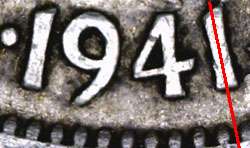
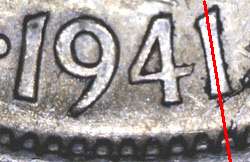
1941 50 Cent
|
For 1942 Charlton lists a wide and narrow date, but looking at his images I see no significant difference to define them by. In a group of 5 examples that came in together, all were slightly different with no clear way to define them into categories. Two had a narrow gap between the 9 and 4 but one of those had a wide and the other a narrow gap between the 4 and 2. Three had a wide gap between the 9 and 4, of which two had a narrow and one a wide gap between the 4 and 2. Within those there were also variations on how the two lined up with the denticles below. With no way to define them, I see no point listing any varieties.
1942 50 Cent
|
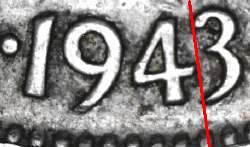
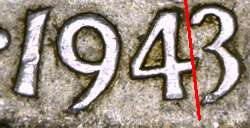
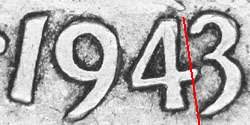
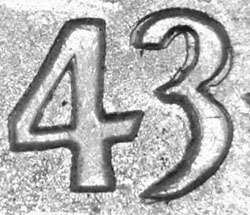
1943 has four variations of wide date, medium and narrow dates plus a distinctive 3/3 date. The wide, medium and narrow dates can be defined by drawing a line down the left side of the three and looking to see how the cross bar of the 4 ends relative to that line. Out of 158 examples examined I noticed varieties within even those major categories and the occasional coin which could not be clearly assigned to a specific category. The wide date was slightly scarcer than the medium and narrow, but not by enough to justify a different price.
There was one scarcer variety and for which a higher value is justified, which is a 3/3 variety with only 4 examples in that 158 coins I examined. This variety is also known ad the Doubled Die 3.
1943 50 Cent
|
1944 half dollars are complex with many combinations of wide and narrow dates as well as high, medium and low 4's, as the last digit was hand punched into every die so can be in a different position on every die. My opinion is wide and narrow dates are meaningless because of the many examples that cannot be defined as one or the other. What is more distinctive is the position of the final 4 relative to the unicorn's hoof where most examples have the back of the four touching the hoof, but there appears to be one die where the back of the 4 is well below the hoof, not touching it at all. There is also a 4/4 variety where the final 4 is distinctly re-punched. There is also a variety with a small die break on the hoof overlaps part of the 4, creating a hoof over 4 nearly identical to the 1949 hoof over 9 type.
Out of 145 random examples I found 13 low 4's, 129 regular 4's and 3 4/4's. Among the regular 4's there was a roughly equal mix of examples that one might define as wide, narrow and ones that could not be defined as either. I feel this justifies higher values for the low 4 and 4/4 examples, but the use of wide and narrow have not real meaning. If examples come to me certified by ICCS to wide or narrow I list them that way, otherwise I do not.
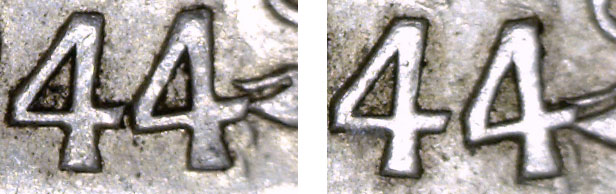
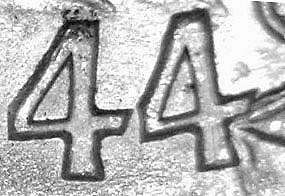
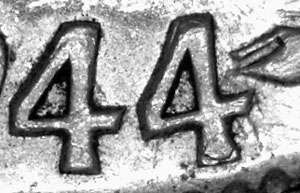
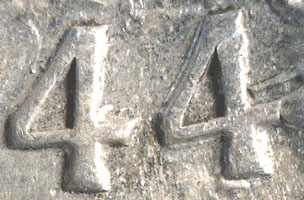
1944 50 Cent
|
In 1945 there are blunt and pointed 5's, plus wide and narrow dates. So far I have found all blunt 5's are wide dates. Pointed 5's come in both wide and narrow dates defined by the spacing between the 4 and 5 but there are several dies with various spacings and some are not clearly wide or narrow dates. In 102 random examples, there were 18 blunt 5's (all wide date), and 84 pointed 5's with a fairly even distribution of wide and narrow dates. With only 18 blunt 5's out of 102 coins, the blunt 5 is scarcer but still easy to fine and we do not feel a higher price is justified. Because the two different five shapes, probably two different punches were involved making this a justifiable variety, but with no difference in value we will no longer list them separately but if you are looking for one or the other we will try to help.
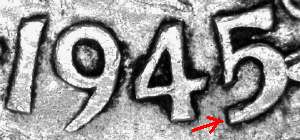
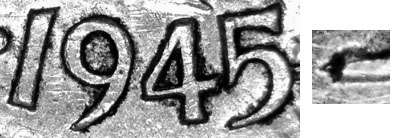
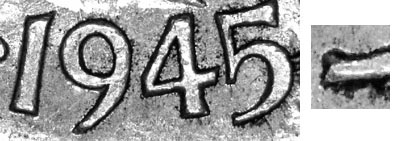
1945 50 Cent
|
1946 half dollars are somewhat complicated, even more so than the standard references indicate where non-"design" types are only listed as wide and narrow dates, but there are clearly wide, medium and narrow date examples. They can be distinguished as follows :
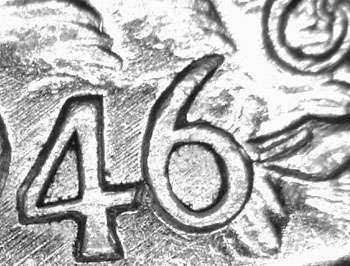
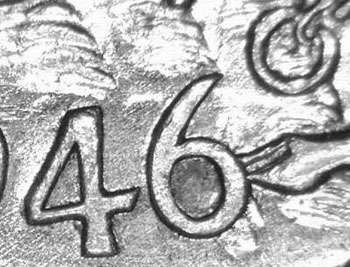
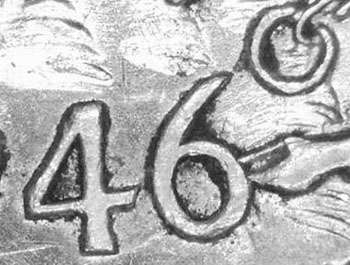
Unless you use three types the middle date would be defined a narrow date based on the distance between the 6 tip and the ring, but as a wide date based on the gap between the 4 and 6. I have now examined 44 examples and found 12 wide date, 30 middle date, and 2 narrow date. The wide and middle dates do not show enough difference in scarcity to justify a different value, but the narrow date where the 4 and 6 touch are much scarcer and do justify a higher value. For now we have decided it is best to just list the scarce narrow dates as a separate variety, and combine the middle and wide dates as just 1946 without designation, but if you wanted to purchase a particular one we will be happy to sort one out for you if you let us know.
1946 50 Cent
|
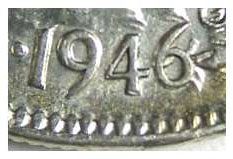
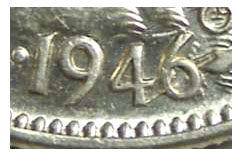
To make the 1946 half dollars even more complicated, one or more of the dies deteriorated in stages resulting various stages of infilling in the 6. First a small die break started inside of the 6, resulting in a small filling at the top, in what we call the "partial design". While not listed in most commonly used references, it was noted by Zoell in his books on Canadian varieties as # R447a. Until recently I thought all were narrow date varieties, but I have now determined these exist for the wide date variety, so clearly two different dies are involved. On one of the dies, that break expands across the 6 to the left where it touches the bottom of the 4, but with still only the top of the 6 filled, becoming a full design (defined by this die break touching the 4) in what we call the "design #2". Finally the break widens inside the 6 until more than 50% of the 6 is fill, becoming what I call the "design #1", and which is the "design" type listed in some references, and is also known as the "hoof" in other references.
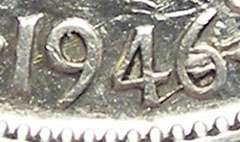
1946 DESIGN 50 Cent
|
1947 half dollars come in four significant varieties. The two major divisions are those minted in 1947 without a small maple leaf after the date, and those minted in 1948 which have the small maple leaf after the date. Each of those are found with either a curved 7 (curved right 7) or a 7 (curved left 7). Wide and narrow date variations exist, but I have not yet found a simply diagnostic for them, and as there seems to be no difference in scarcity between narrow and wide dates, for now I am not listing them here. The maple leaf types are much scarcer than those without, and the maple leaf with the straight 7 (or curved left 7) is very rare.
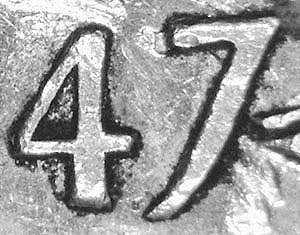
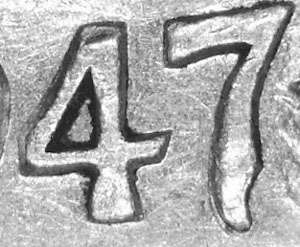
1947 50 Cent
|
India received its independence on August 14, 1947 requiring that IND IMP (India's Emperor) be removed from all British Commonwealth coins dated 1948 or newer. A problem similar to that in 1937 when Edward the VIII abdicated, the new obverse designs for coins all over the British Commonwealth had to be prepared at the Royal Mint in England. Those for Canada were not ready at the beginning of 1948 and coins were needed, so early in 1948 coins were struck dated 1947 so that the IND IMP design could still be used but a small maple leaf was placed after the date indicating minted in 1948.
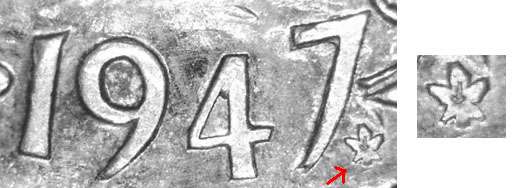
1947 MAPLE LEAF 50 Cent 1947 maple leaf (ML) half dollars had a total mintage of about 38,400 roughly double that of the 1948 silver dollar but much lower than any other 50 cent of this period. There are two varieties where the bottom of the 7 can curved left (also known as a straight 7) or right (pointed 7). While the curved left (straight 7) examples are scarce, the 1947 maple leaf curved right examples are rarely encountered and in my experience are scarcer than the 1921 5 cent. Most 1947 maple leaf half dollars are weakly, particularly struck in the upper left of the reverse shield.
|
Because the dies for the 1948 half dollars were not ready until late in the year and the mintage of 1948 50 cents was low and the coins are today scarce. The Charlton standard catalogue lists narrow and wide date (with high and low 4) 1948 half dollars but I find the differences to be relatively insignificant and difficult to sort out and not important enough to be bothered with here.
1948 50 Cent
|
1949 half dollars are complicated with a combination of the position of the 4's relative to the 9's, with high, medium and low 4's, and the size of the gap between the first 9 and the 4, with wide and narrow gaps. The more we look, the more varieties we find (there are some with even higher 4's), and every die must have been different. We have noticed that the low 9's seem to be a little scarcer than the high and medium 9's but not by enough to justify any difference in value, so at this time I will not be separating them in our listings.
The one distinctive variety is that called the "hoof" or "hoof over" where a die crack extends from the unicorn's hoof and onto the 9, making it look like the hoof overlays part of the 9. They would have been struck late in the working life of just one die, and are scarce and the only variety we now feel justifies being listed separately at a higher value.
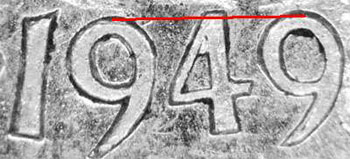
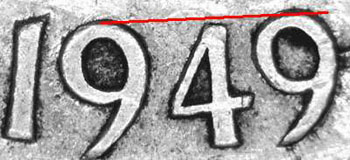
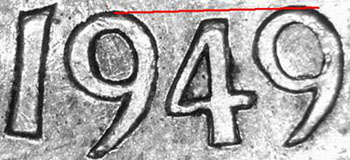
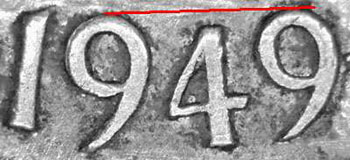
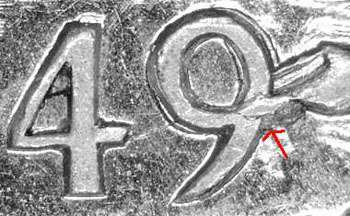
1949 50 Cent
|
1950 half dollar dies usually have some ground lines visible inside the 0 of 1950, which can be anything from vary from strong fully across the 0 from top to bottom to only a trace in the lower right. Some examples known as the 1950 no design have no trace of the ground lines inside the 0 although there may be a die break across the date which cuts through that 0. Most reference now list three varieties of this date:
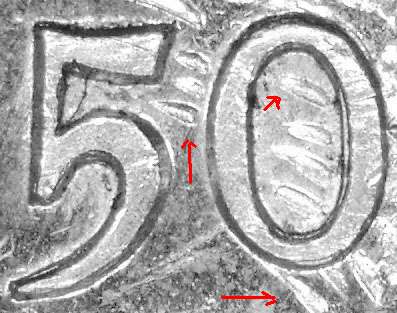
1) Full design - four visible ground lines inside the 0 with the top line extending more than half way across. There will be three lines visible between the 5 and 0.
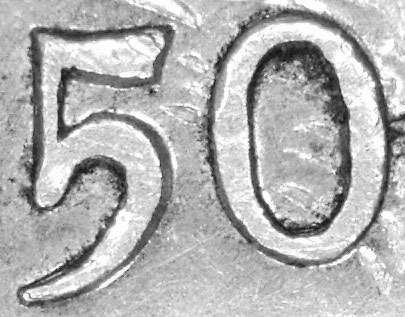
2) Half design - Anywhere with one to four lines visible inside the 0 with the top one not extending more than half way across the 0. If any trace of even one line is visible the example cannot be called no design. There are also traces of ground lines between the 5 and 0.
The Charlton Standard Catalogue still lists the half design examples and at slightly higher prices than full designs but there is no difference in rarity so no difference in value can be justified. In my own opinion, as these varieties result from die polishing, not die cutting, and there is a very broad range of how clear or complete the lines are, they are not really legitimate varieties and I will not list them separately here. I notice the CCN trend sheet no longer lists them.
.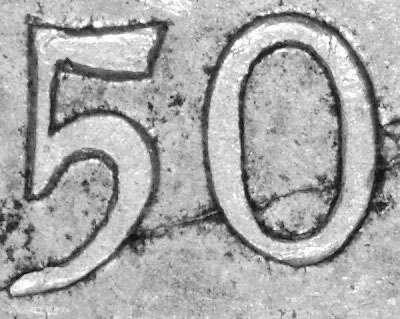
3) No design - no trace of ground lines inside the 0 or between the 0 and 5, or to the lower right of the 0. One must look under magnification to be certain no lines are visible inside the 0.
4) No design with die break. The same characteristics as the regular no design but with a clear die break across the 0 and extending to the bottom of the 5. Originally only examples with this die break were considered true no design's but today the die break is no longer considered necessary for this variety. Those with the die break are scarcer and I do differentiate and price them higher. Because these are very distinctive they are accepted in all references as a distinct variety.
1950 50 Cent
|
1951 50 Cent
|
1952 50 Cent
|
1953 50 Cent NSS The early 1953 dies had the shoulder fold weakly cut resulting in the shoulder fold either not visible or partly and weakly visible not present. The Queen's shoulder appeared bare which many people felt was inappropriate. Known as the No Shoulder Strap (NSS) or No Shoulder Fold (NSF) variety, the easiest way to confirm these is by the strong serifs on the I's in II and DEI. NSS 50 cents were intended to have a small date, easily identified because all for digits of the date are the same size. These occasionally show up with the larger date (the last 3 digits are bigger than the first), intended for the SS type, and while these are technically mule errors they are generally not thought of that way.
|
1953 50 Cent SS Later in 1953 the dies were re-designed with a deeper shoulder fold which is usually visible on the coins, as well as the larger date. Known as the Shoulder Strap (SS) or Shoulder Fold (SF) variety, the easiest way to confirm this variety is by the very small serifs at the top and bottom of the I's of II and DEI that make the I's appear nearly straight. I am not aware any SS examples are known with a small date.
|
1954 50 Cent
|
1955 50 Cent
|
1956 50 Cent
|
1957 50 Cent
|
1958 50 Cent Some 1958 half dollars have a small dot below the final A of CANADA, resulting from die damage.
|
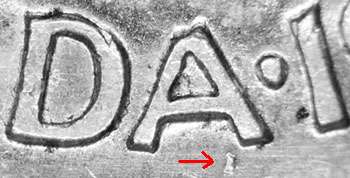
1958 Dot 50 Cent Some 1958 half dollars have a small dot below the final A of CANADA, resulting from die damage.
|
1959 50 Cent
|
1960 50 Cent
|
1961 50 Cent
|
1962 50 Cent
|
1963 50 Cent
|
1964 50 Cent
|
1965 50 Cent
|
1966 50 Cent
|
To celebrate Canada's 100th anniversary as a country, in 1967 standard circulating coins all depicting animals common to Canada, with a howling wolf on the 50 cent. The examples I list here are exceptional examples, either Proof-like, Specimens or high end mint state, many with a cameo portrait and/or wolf. Lesser even MS-60 to 62, or specimen and proof-like with any problems, are only worth the silver they contain and I sell those off in store to silver buyers. On coins from specimen sets it is not unusual to find them with an attractive blue tone, although it is often only on the wolf side.
1967 50 Cent
|
With the switch from silver to nickel coins in 1968, half dollars was reduced from the 29.72 mm of the previous silver coins to 27.13 mm, making them easy to differentiate. All 50 cents after 1967, other than some odd mint commemorative's, are struck to the 27.13 mm size including those struck of silver for the proof sets starting in 1996.
Nickel half dollars from 1968 to 1986 are very common and average ones are not of enough value for us to list here. I only list either exceptionally high quality examples (normally from Proof-like, Specimen or Proof sets) or scarce varieties, but as you can see even they are not of significant value. Starting in 1987 the mintages are dramatically reduced as the mint stopped issuing them through banks, and most dates after 1986 command a small premium with the newest dates being the most difficult to find.
Please note that up to 2011 when I describe a coin to be Proof-like (PL) I mean a coin from a mint set, intestinally struck to a higher quality than normal, but worth less than a MS (Mint State) coin from a bank roll in the same grade. They are fairly easily differentiated by their strike and luster. ICCS and some references call such coins "NON-CIRCULATING NUMISMATIC MINT STATE" which I feel will cause confusion in beginning collectors. Starting in 2012 the mint stopped making intentionally nicer coins for the standard sets and the coins are all simply MS (mint state) except for specimen and proof examples.
1968 50 Cent The inscription on the ribbon across the bottom of the arms should read A MARI to the left and AD MARI to the right. Some 1968 examples have a strong A in AD, some a weak or only traces of the A in AD, but some examples have not trace of the A in AD which are the ones I will list below as Missing A varieties.
|
1969 50 Cent
|
1970 50 Cent
|
Beginning in 1971, the mint begins issuing three different striking qualities, with a fourth added in 1981:
Mint state (abbreviated MS) which are coins struck for issue through the banks and have average lustre and surface qualities. In most cases MS coins have little value unless in the highest range of the MS coins, and those are seldom seen. We don't list most dates in MS because they are not of high enough value to justify the time and trouble to list and/or ship them.
Proof-like (abbreviated PL) are standard mint set coins, usually from the pliofilm packaged sets, red double penny sets, and later the blue book set, but in later dates there were a variety of other types of sets they can come from. PL coins have a much higher lustre than MS coins, mostly because they are struck from dies in their newest die state. They also have very minimal marks (the average PL is a PL-64) as they did not go through as many of the mint handling processes as MS coins do, but they are not perfect coins and one should not expect them to be absolutely mark free.
Specimen (abbreviated SP or SPEC) which were in the black leather double dollar sets from 1971 to 1980, and for later dates in various types sets. Like PL coins they are struck from dies in their freshest die state but differ in being double struck to give them a higher lustre and sharper images, and they do not go through any mint handling processes before going into the sets so are nearly mark free. The rims tend and edges tend to be a little sharper although this is not obvious on a casual inspection. When we list a coin as being a specimen, it is because we personally took it from a specimen set before listing it here.
Proof (abbreviated PR) coins are very nice coins found mostly issued in the double dollar black leather boxed proof sets starting in 1981, although some specialty coins did come other ways. The coins are clearly differing from the other striking qualities by being double struck from specially prepared dies so they have mirror fields and frosted images (and ultra cameo effect) and are specially handled so they go into the sets in near perfect condition as possible.
1971 50 Cent From 1971 to 1973 the coins in the double dollar specimen sets rest on the red flocking which in most sets has deteriorated and reacted with the coins, damaging the surfaces, resulting in finding nice specimen examples from these there dates somewhat difficult.
|
1972 50 Cent
|
1973 50 Cent
|
1974 50 Cent Specimen set packaging was improved in 1974 so that the packaging no longer damages the coins and nice specimen examples becoming much easier to find than for 1971 through 1973. Some circulation (MS) strikes of 1974 50 cents are missing the S of the T S designers initials at the base of the shield.
|
1975 50 Cent
|
1976 50 Cent Starting in 1976 it is very unusual to see proof-like strikes with any significant cameo effect.
|
1977 50 Cent
|
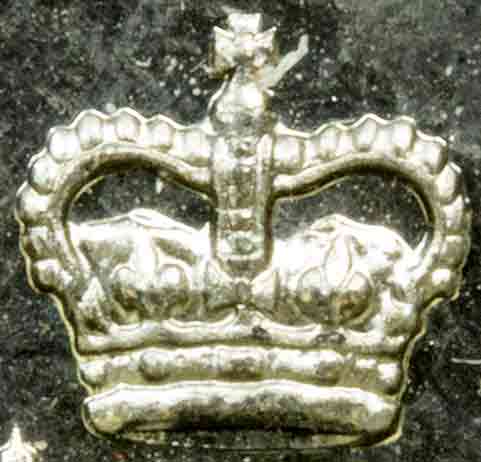
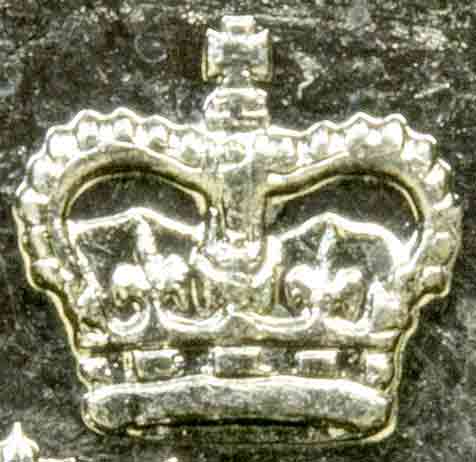
1978 50 Cent 1978 half dollars are found with two shapes of jewels on the band of the crown dividing the date. The common square jewel (SJ) type has three rectangular jewels and is the most common in rolls and sets. The scarcer round jewel (RJ) type has a square center jewel flanked by two rounded jewels and it is rarer in rolls it is much more difficult to find in proof-like and specimen sets.
|
1979 50 Cent 1979 half dollars are found with two bust varieties. On the common type the front tip of the Queen's portrait is slightly rounded, found in mint State, proof-like and specimen sets. The scarcer pointed tip type is only found in proof-like and specimen sets.
|
1980 50 Cent
|
1981 saw the introduction of proof sets to replace the double dollar specimen sets. The proof coins have frosted images against mirror fields and while specimen strikes continued to be struck, they were in other types of sets. Whether proof or specimen coins are easier to get as single coins, depends mostly in the value of the intact sets they come from. Generally after 2012 most proof sets are worth more intact than broken up so those coins are harder to get in proof.
1981 50 Cent
|
1982 50 Cent There are two varieties of 1982 half dollars. The scarcer small (flat bust) bead variety is only found on some circulation strikes, with a slightly more detailed portrait and most easily confirmed by the straight stick like attachment point of the jewel at the back of the tiara. The more common large bead variety (raised bust) is found on most circulation and all Proof-like, Specimen and Proof examples, and has a less detailed portrait with a flaired attachment of that bead to the back of the tiara.
|
1983 50 Cent
|
1984 50 Cent
|
1985 50 Cent
|
Half dollars were seldom seen in circulation after the mid-1960's but were struck in fairly large numbers until 1985. Beginning in 1986 mintages were reduced and they are somewhat difficult to find, although not very expensive, although they are available in mint sets. The exceptions are 1991 and the 2002 special 50th anniversary of accession issue, which were minted in larger numbers and an attempt was made to put them into circulation, but very few actually did circulate beyond the first to second person to receive them.
1986 50 Cent
|
1987 50 Cent
|
1988 50 Cent
|
1989 50 Cent
|
1990 50 Cent
|
1991 50 Cent
|
1992 50 Cent 1992 was Canada's 125th anniversary of confederation, and all 50 cents of this year have the date shown as the double date 1867-1992 to either side of the reverse crown.
|
1993 50 Cent
|
1994 50 Cent One of the 1994 half dollar dies developed a small die pit inside the G of DG on the obverse inscription, resulting in a raised dot inside the G on the coin, known as the 1994 DOT variety.
|
1995 50 Cent A set of four sterling silver proof quality 50 cents was issued in 1996 commemorating Canadian birds, issued at the same standards as the 1996 and later proof half dollars.
|
From 1996 to 2011 all Proof strike half dollars were struck in sterling (92.5%) silver at 9.3 grams so contain 0.276 ounces of silver. Proof-like, specimen and circulation strike coins continue to be pure nickel at 8.10 grams, until the 2001 when they change to nickel plated steel. The holders for proof sets are not sealed air tight, so air can get in and often causes the silver coins to develop a light golden brown toning, especially around the edges. Tone free (pure white) examples can be difficult to find for some dates. One should expect at least a little toning around the edges on these coins, which can be fairly attractive, but if you prefer white tone free examples please specify such on your order and I can usually accommodate such requests. Examples with heavier toning will be noted in the descriptions.
1996 50 Cent A set of commemorative 50 cents was issued in 1996 with Proof quality images of baby animals on the same sterling silver blanks as the regular Proof 50 cents.
|
1997 50 Cent The Canadian Coin News trend sheet lists Ottawa and Winnipeg half dollars separately at different prices. While still in proof-like sets they can be identified to Ottawa or Winnipeg by the position in the sets but once removed they cannot be differentiated and so I list all examples at the same price (lower of the two listed). A set of Proof sterling silver commemorative 50 cents was issued in 1997 depicting dogs.
|
1998 50 Cent In 1998, Proof-like coins are found with and without a W mint mark, as the sets minted in Winnipeg Mint have the W, while those minted in Ottawa do not. All circulation (MS), specimen and proof coins were minted at Ottawa without mint mark. The finish on 1998 proof-like coins returns to high luster while specimen coins retain the matte fields with high lustre designs that first appeared in 1996. A set of Proof sterling silver commemorative 50 cents depicting whales, and others depicting set depicting sports events, were also minted in 1998.
|
1998 COMMEMORATIVE 50 cent To commemorate the Royal Canadian Mint's 90th anniversary special sets were struck with the sizes, sterling silver alloy (other than the 1 cent), and general reverse designs of the 1908 coins, but with an obverse showing Queen Elizabeth's portrait and date as "1908 - 1998". The early sets have an antiqued matte-proof finish that proved unpopular with collectors so were discontinued and are now the scarcer of the two finishes. The later sets are mirror-proofs.
|
1999 50 Cent A set of Proof sterling silver commemorative 50 cents depicting cats was issued in 1999 and is the most popular and difficult to find of the animal series. An additional silver proof 50 cents set was issued commemorating sporting events.
|
1999 P TEST 50 Cent In 1999, as a cost saving measure, the Canadian Mint made plans to strike 1, 5, 10, 25 and 50 cent coins on nickel plated steel blanks which were first nickel plated, then copper plated and then for all denominations other than the 1 cent, nickel plated again. A P was placed below the Queen's portrait to indicate a plated steel blank. First struck only as test tokens for vending machine companies for calibrate purposes, those companies were supposed to return them to the mint. Some ended up on the market at very high prices so the mint got in on the action selling 20,000 sets to collectors at much lower prices. Packaged like Proof-like sets their exact status is unclear and I prefer to call them Proof-likes, but others including ICCS call them Mint State. A mintage of only 20,000 means they are nearly as scarce as 1948 dollars. The vinyl packaging leaves a light film on them that can be removed with rubbing alcohol.
|
2000 50 Cent All 2000 half dollars in MS, PL and Specimen were intended to be on pure nickel blanks without the P for plated, although some have the W for the Winnipeg mint. A small number of 2000 half dollars with the "P" were accidental released mounted in souvenir clocks, although only some of the clocks have this. The final sets of Proof sterling silver animal (birds of prey) and sports commemorate 50 cents was issued in 2000.
|
2001 50 Cent Circulation strike "P" half dollars on plated steel blanks with the P mark were struck in 2001. From 2001 through 2003 silver proof half dollars commemorating festivals across Canada were struck, four per year.
|
Two different half dollars were struck in 2002, both doubled dated as 1952 - 2002 to commemorate the 50th anniversary of Queen Elizabeth's ascension, but only the type known as the Ascension type was issued for circulation with large numbers issued through post offices and Hudson Bay stores, making them the last circulating Canadian half dollar. They did not circulate widely as people found them interesting an quickly put them away.
2002 Ascension 50 Cent This Ascension type was the only type issued for circulation and depicts the Queen as she looked on her ascension to the throne in 1952, using a young portrait as depicted on her 1953 coronation medals. There is a crowned E II R above CANADA to the left, with D G REGINA (Latin for By God's Grace Queen) to the right. The dates 1952 - 2002 are on the reverse below the Canadian arms with 50 CENTS above. These are found in bank rolls for circulation, a 5 pack mint issued in a card holder in MS, the special edition purple envelope mint sets in proof-like quality, and silver proofs in a special edition proof set.
|
2002 Regular Head 50 Cent This econd type of 2002 50 cent has the regular portrait of Elizabeth but with the dates as 1952 over 2002 below, slightly to the lower left. The reverse is the normal Canadian arms as on previous years except the date has been moved to the Queen's head side. Not issued for circulation this type is only found in the regular Proof-like, specimen and normal edition silver Proof sets. The mint also issued a variety of special commemorative half dollars in 2002, using the same Queen's portrait but with different inscriptions including the denomination on the obverse to the left of her head. I list these when available but as the packaging too large for letter mail, extra postage will apply if you need the original packaging. If I take the coins out and send the coin in a standard 2x2 it will not add to the postage.
|
2003 was an interesting year for Canadian coins, with a number of varieties including the introduction of a new effigy of the Queen without a crown. No 2003 half dollars were issued for circulation so do not occur in bank rolls. They are only found in mint sets.
2003 50 CENT Old Effigy No 50 cents were issued in bank rolls in 2003, so they are only found in mint sets. Coins struck earlier in 2003 have the crowned Queen's effigy first introduced in 1990. These are found in the regular proof-like and specimen sets with the P for plated below her head, and without the P in the silver proof sets. The mint issued a variety of special commemorative half dollars in 2003, all with this old effigy portrait but some variation in position for the date and denomination. I list these as available but most came in packaging too large to mail by letter mailer so if you want that original packaging extra postage will apply. If I take the coins out of that packaging and just send the coin in a 2x2 there is no extra postage.
|
2003 50 CENT New Effigy Later in 2003 to celebrate the 50th anniversary of the Queen's coronation a new bust design was introduced with a more mature portrait but without a crown. This design became the standard in following years so is more commonly known as the New Effigy. These are only found in special edition mints sets which were all struck at the Winnipeg mint and so have the W for Winnipeg and the P for plated steel blanks, below the Queen's bust, and is the only year the W and P are found together.
|
Starting in 2004 all standard coins have the New Effigy uncrowned portrait introduced in 2003.
2004 50 Cent No 2004 50 cents were issued as MS in rolls but are available from proof-like, specimen and proof sets. Other than silver proofs these coins are marked with the P for plated. A specimen commemorative set of 50 cents as issued commemorating the various portraits used previously for the Queen, which included a laureate portrait (type of 1953 to 1964), tiara portrait (1965 to 1989), Diademed portrait (1990 to 2003), and the uncrowned portrait used on normal coins starting in 2003.
|
2005 50 Cent In 2005 Mint state examples were again issued in bank rolls, although no rolls were actually issued through banks and you had to order them from the mint, so they were issued in MS, specimen, proof-like and silver proof, with all but the silver proofs still baring the P below the Queen's bust. A series 2005 special edition half dollars were issued in sterling silver, mostly with specimen finish but a few types have proof finish, all of which have a variation on the new effigy portrait.
|
2006 50 Cent All 2006 50 cents, other than silver proofs are on plated blanks. Those struck earlier in the year have the P for plated but later in the year the P was replace by the stylized maple leaf mint logo. The mint logo does not indicated plated as in later years it also occurs on silver proofs. Those in mint rolls for circulation (although none actually circulated) all of the P, as do all specimen strikes. Silver proof on solid blanks do not have the P. In the proof-like sets there are two separate issues, with the early year sets having the P, but later year sets having the mint logo and are scarce. A special silver proof half dollar with a gold plated reverse was also issued in the covers of 2006 mint reports.
|
Starting in 2007 all half dollars have the stylized mint logo no matter if standard types on plated blanks or solid sterling silver Proofs. Limited numbers of circulation strike (MS) examples were issued in bank rolls every year after this but none were available through banks and had to be ordered through the mint.
2007 50 Cent
|
2008 50 Cent Besides the regular types of 50 cents, in 2008 a rather odd commemorative for milk delivery in Canada as struck in proof quality as triangular sterling silver with the reverse depicting a milk bottle and cow's head covering with clear green enamel.
|
2009 50 Cent
|
2010 50 Cent Various types of larger 50 cents (35 mm) were struck in 2010, which I will lists as giant 50 cent, which are offered here in 2x2 card holders, not the original mint packaging.
|
In 2011 the mint stopped making intentionally superior coins for Proof-like (standard) mint sets, rather using normal MS coins that had not gone through all of the mint handling processes rolled coins go through. There is no way to differentiate between MS-63 or better coins from sets vs bank rolls. Examples from Specimen sets still have the frosted backgrounds with mirror designs. Starting about 2011 while the 50 cents were still included in the standard mint sets but not in most of the specialty mint sets with the commemorative quarters and later brass dollars.
2011 50 Cent
|
2012 50 Cent A special commemorative giant (41.5 mm) silver plated 50 cent was issued to commemorate the 60th anniversary of the Queen's accession to the throne.
|
2013 50 Cent
|
2014 50 Cent
|
2015 50 Cent
|
2016 50 Cent
|
2017 50 CENT Canada's 150'th anniversary as a country was celebrated in 2017. Just over 875,000 of each design were issued, the normal Canadian arms design in MS (rolls) and some mint sets including specimen sets, and a commemorative design of a stylized maple leaf known as the 150th Logo, also in mint rolls and certain mint sets but not specimen sets.
|
2018 50 Cent
|
2019 50 Cent
|
2020 50 Cent
|
2021 50 Cent
|
2021 50 Cent George VI To celebrate the 100th anniversary of the adoption of the Canadian coat of arms a 2021 50 cent was issued based on the first appearance of those arms on the 1937 50 cent. The obverse depicts George the VI using his titles as they appeared on the 1937 50 cent designed by T.H. Paget. The reverse depicts the Canadian arms used that year, design by Kruger-Gray, but with the date as 2021. It is interesting that we now have a Canadian Coin dated 2021, that names George VI as Emperor of India (a title he no longer held after 1948). I managed to get a rolls of these and all of the coins in the roll were MS-63 or better, with an exceptionally brilliant mirror finish.
|
Please note that up to 2010 I describe coins as Proof-like (PL) if they come from a mint set. PL coins are easily differentiated by their superior strike and luster, with only very minor bag marks and while nicer than MS coins from bank rolls they are easier to find in high grades and usually worth less. ICCS and some references refer to these as NON-CIRCULATING NUMISMATIC MINT STATE which I find confusing which is why I to call them Proof-like. In 2011 the mint started putting standard Mint State coins in the normal mint sets, although these bypassed some of the mint handling procedures so these coins will usually be MS-64 and MS-65. This makes those grades more common than for earlier dates. Specimen and proof sets still use specially struck coins with distinctive finishes.

© 1997-2024 R & T Enterprises Ltd.
 |
 |